


Last updated: July 2026
Wild Trail Hiker is reader-supported. We may earn a commission when you buy through links on this page, at no extra cost to you. We only recommend products we’d consider taking on a multi-day trip ourselves.
Before You Go
The Milford Track is New Zealand’s most in-demand Great Walk, and hut and transport bookings for the peak December to February window routinely sell out within minutes of release. You must book huts and transport months ahead, and there is no flexibility once you are on the trail: the track can only be walked in one direction over four days, there is no backtracking, no shortcuts, and no cellphone coverage anywhere on the route. Camping is not permitted, huts only, and DOC checks bookings at the trailhead. If your dates matter more than walking this specific trail, that is worth knowing before you plan around it.
Why This Trail
In 1908, a London magazine editor slapped the headline “The Finest Walk in the World” on an account of the Milford Track written by English poet and alpinist Blanche Baughan. The name stuck for over a century, and it is not hard to see why. Four days through Fiordland National Park, part of the Te Wāhipounamu UNESCO World Heritage Area, takes you from beech forest along the Clinton River, up through alpine tussock to a pass over 1,100 metres, and down a valley strung with waterfalls to a fiord ringed by some of the tallest sea cliffs on earth.
What sets Milford apart from other multi-day walks is the entry and exit. There is no road to either end. You start with a boat trip across Lake Te Anau and finish with a boat trip across Milford Sound, so the whole experience is bracketed by water before the walking even starts. In between, the track is entirely self-contained: no resupply, no phone signal, no vehicle access, just three huts and whatever weather Fiordland decides to throw at you. Fiordland gets up to 9,000mm of rain a year, among the highest rainfall anywhere on the planet, and the track’s reputation for waterfalls is a direct consequence of that. Sutherland Falls, a three-tier 580 metre drop, is the standout, but the whole route is threaded with smaller cascades that would be a headline feature on almost any other trail.
Compared with New Zealand’s other Great Walks, Milford’s appeal is concentration: four days deliver genuine alpine scenery, dense rainforest, and a fiord finish in a single, tightly managed package. That is also why it is the hardest of the Great Walks to book.
Trail at a Glance
| Spec | Detail |
|---|---|
| Distance | 53.5 km (33.2 miles) one-way, Glade Wharf to Sandfly Point |
| Duration | 4 days / 3 nights (Clinton Hut, Mintaro Hut, Dumpling Hut) |
| Difficulty | Moderate to hard. DOC rates the Great Walks season track as Intermediate; day 3 over Omanui/McKinnon Pass and day 4’s 18km push are the crux |
| Best season | Great Walks season, 1 November to 30 April (huts ranger-staffed, bridges installed, avalanche risk actively managed) |
| Permits | Hut bookings mandatory in the Great Walks season. Booking opens each May for the following season (the 2026/27 season opened 13 May 2026); high-demand dates can sell out within minutes |
| Start trailhead | Glade Wharf, reached by boat from Te Anau Downs — Glade Wharf on Google Maps |
| End trailhead | Sandfly Point, followed by a short boat ride to Milford Sound — Sandfly Point on Google Maps |
Neither trailhead has road access. Both are reached only by scheduled boat, which is why the transport booking matters as much as the hut booking.
Trail Map
Milford Track on AllTrails: elevation profile, user reviews and current conditions from recent hikers, plus day-by-day section maps for each leg of the walk.
Milford Track walking guide (official DOC brochure, PDF): the source-of-truth map, hut layout and elevation profile from the Department of Conservation.
Getting There and Away
Getting there (to Glade Wharf): The nearest hub is Queenstown, New Zealand’s main South Island gateway, about 2.5 hours by road from Te Anau, the actual staging town for the walk. From Te Anau, a bus runs to Te Anau Downs (about 30 minutes), where you connect with a boat to Glade Wharf (roughly 1 hour 15 minutes). There is no vehicle or private access to the start of the track, and all transport must be booked in advance through an independent operator (Tracknet, RealNZ, or Fiordland Outdoors/Trips and Tramps water taxi are the established names). Fly into Queenstown Airport, then drive or bus to Te Anau the day before your track start; flying directly into the smaller Te Anau airfield is possible but far less common and more expensive.
Getting away (from Sandfly Point): A short boat ride (15 to 20 minutes) takes you from Sandfly Point to the Milford Sound visitor terminal. From there, scheduled buses connect back to Te Anau and on to Queenstown, a journey of roughly 5.5 hours to Queenstown with a stop in Te Anau. Because this is a point-to-point track finishing well away from where it starts, almost everyone books a same-day bus connection rather than staying overnight at Milford Sound, which has very limited accommodation.
Staging town: Te Anau is the practical base both before and after the walk. Book your pre-trail night there well ahead in peak season, since the town fills up around the same hut-booking windows that sell out the track itself. Most walkers do not need a post-trail night in Milford Sound or Te Anau, since the afternoon bus back to Queenstown runs the same day you finish.
Route Overview
Distances and times below are from DOC’s official track notes.
Day 1: Glade Wharf to Clinton Hut (5 km, 1 to 1.5 hours)
After the boat cruise from Te Anau Downs, the walking starts gently: a short, mostly flat stroll through beech forest along the Clinton River to Clinton Hut, where every walker spends the first night regardless of pace. It is a deliberately easy introduction, more a settling-in than a real hiking day, and most people arrive with hours of daylight left. A short side trip to a wetland boardwalk near the hut is worth the fifteen minutes if you have the legs for it, and the swimming holes near the hut are a genuine highlight on a warm afternoon.
Day 2: Clinton Hut to Mintaro Hut (17.5 km, about 6 hours)
The real climbing begins here, a long, gradual ascent following the Clinton River to its source at Lake Mintaro, at the base of Omanui/McKinnon Pass. You pass Hirere Falls and get your first proper look at the pass and the Pompolona icefield above it. The valley walls close in and steepen as you climb, and the vegetation shifts from lowland forest to subalpine scrub by the time you reach Mintaro Hut. This is the longest day by distance, and most of the elevation gain for the whole track is banked here, in preparation for the pass crossing the next morning.
Day 3: Mintaro Hut to Dumpling Hut (13 km, 6 to 7 hours)
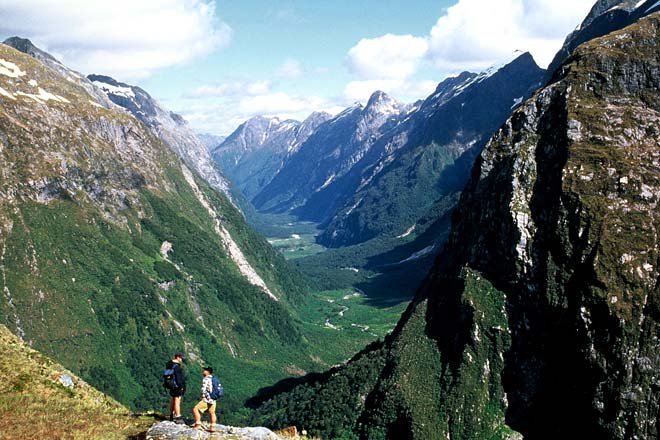
The crux day. From Mintaro Hut you climb to Omanui/McKinnon Pass, at 1,154 metres the highest point on the track, past a memorial to the trail’s namesake explorer and views back down the Clinton Valley that make the climb worth it on a clear morning. From the pass shelter, the trail drops steadily through an alpine garden and past a string of waterfalls along the Roaring Burn to the valley floor. Before Dumpling Hut, most walkers detour to Sutherland Falls, DOC lists the round trip at about 1.5 hours, though several trip reports put it closer to 2 to 3 hours if you are tired or the track is greasy underfoot. It is worth the extra time regardless: the falls drop 580 metres in three leaps from Lake Quill and are genuinely one of the most memorable things on the whole walk.
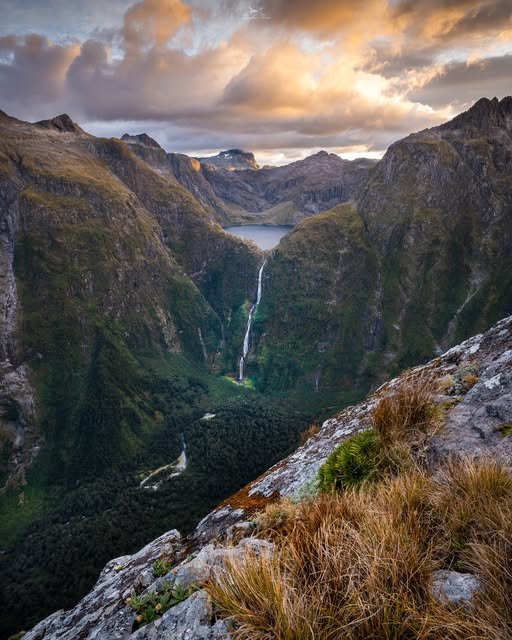
Day 4: Dumpling Hut to Sandfly Point (18 km, 5.5 to 6 hours)
The longest day, and the one with a hard deadline: you need to reach Sandfly Point in time for the early afternoon boat, so pace planning matters more here than on any other day. From Dumpling Hut the trail follows the Arthur River past the historic Boatshed, then reaches Mackay Falls and the curiosity of Bell Rock. The final three kilometres run on a smooth, wide track cut by a prison labour gang in the 1890s, a strange, almost civilised finish to a wild four days. The short boat ride from Sandfly Point delivers you into Milford Sound with Mitre Peak rising directly ahead, about as good a final view as any multi-day trail offers.
What to Expect
Terrain. Mostly well-formed, maintained track: boardwalk through the lower valleys, gravel and packed earth on the climbs, and a rockier alpine surface over Omanui/McKinnon Pass itself. Day 3’s descent (over 500 metres up, then roughly 1,000 metres down to Dumpling Hut) is the steepest and most knee-testing stretch on the route. No scrambling or exposure in the technical sense, but the pass crossing is genuinely alpine and weather-exposed.
Weather. Fiordland is one of the wettest places on earth, up to 9,000mm of rain a year, and conditions change fast regardless of season. Snow, strong wind and heavy rain can occur even in mid-summer, particularly at Omanui/McKinnon Pass. Both the Clinton and Arthur Valleys can flood and become impassable in heavy rain; DOC actively monitors this during the Great Walks season, which is a big part of why walking outside that window is discouraged.
Wildlife. Keas, New Zealand’s famously inquisitive alpine parrots, are common around the pass and will investigate anything left unattended, gear included. Sandflies are the other constant, especially at low-lying, damp spots (Sandfly Point earns its name honestly).
Crowds. Because hut numbers are capped at 40 people a night and every walker starts on the same schedule, the track has a genuinely consistent, unhurried feel in season rather than a crowded one. You will see the same faces at each hut for four days, which most people end up enjoying rather than resenting.
Signature features. Sutherland Falls, Omanui/McKinnon Pass, Mackay Falls, Bell Rock, and the boat approach into Milford Sound with Mitre Peak overhead.
Water: sources, safety, and treatment
Water is genuinely everywhere on this track, streams, rivers and hut supplies, so carrying capacity is not the issue. Safety is more mixed. Hut water is largely roof-collected rainwater and DOC posts advisory signage rather than a blanket “safe to drink” claim, so treat it as good practice to filter or treat hut water rather than assume it is clean. River and stream water along the Clinton and Arthur valleys is generally regarded as clean by trip reports and local guides, but giardia is present in New Zealand backcountry generally, and the responsible default is to treat everything you drink rather than gamble on a source-by-source basis.
One additional hazard specific to this trail: didymo (an invasive algae) is present in Lake Te Anau and Milford Sound but not currently in the Clinton or Arthur rivers. Do not draw water from the lakes at either end, and follow the Check, Clean, Dry protocol with footwear and gear moving between the lake sections and the river valleys, so you are not the one who introduces it upstream.
A lightweight squeeze filter is the practical choice here: fast, no batteries, and more than adequate for the volume of clean-looking alpine water on this route. See our best water filters for hiking guide for picks.
Logistics
Hut bookings open through DOC’s website each May for the following Great Walks season (13 May 2026 for the 2026/27 season), and December to February dates can sell out within minutes of release, so have your dates and an alternative or two ready before the booking window opens. Hut fees for the 2026/27 season are NZ$106 per person per night for New Zealand residents and NZ$152 for international visitors (roughly NZ$318 and NZ$456 respectively for the full three nights), with proof of residency required for the local rate.
Transport is a separate booking from your hut nights and must be arranged with an independent operator well ahead of time, since seats on the boats and buses sell out alongside the huts. A DOC ranger is based at each hut through the season and can help with track conditions and safety questions, but rangers do not sell food or gear, so arrive fully self-sufficient. There is no rubbish collection on the track: carry out everything you carry in.
Mandatory Gear Checklist
This is one of the wettest tracks in the world, and “I’ll be fine with a light shell” is how bad Milford Track stories start.
- Full waterproof jacket and overtrousers. Not water-resistant, waterproof, with taped seams and a real hood. See 8 Best Hiking Jackets.
- Sturdy, broken-in boots with reliable wet-weather grip. Mud, boardwalk, river spray and a steep descent off the pass all demand more than trail runners. See 8 Best Waterproof Hiking Boots.
- A warm layering system: wool or synthetic base layers, a mid layer, and an insulated jacket. Temperatures at Omanui/McKinnon Pass can sit close to freezing even in summer if wind and rain combine. See 8 Best Insulated Jackets for Hiking.
- A 3 to 4 season sleeping bag. Huts provide mattresses only, no bedding, and bunkrooms are unheated overnight. See 8 Best Hiking Sleeping Bags.
- A 40 to 60 litre pack with a waterproof liner or dry bags inside it. See 5 Best Multi-Day Backpacks.
- Cooking and eating kit: pot, mug, plate and cutlery. Huts provide gas cooktops but no utensils.
- Sandfly repellent, kept somewhere accessible, not buried at the bottom of your pack.
- Headlamp with spare batteries, map, and a first aid kit.
For the full category-by-category kit with specific picks, see our companion guide, What to Pack for the Milford Track.
Honest Assessment
Who should walk it: hikers with at least one or two multi-day trips already behind them, comfortable with 5 to 7 hour walking days and a genuine alpine pass crossing, and organised enough to book both huts and transport six to nine months ahead. If you want a complete, well-supported four-day wilderness experience without needing technical skills, Milford delivers about as reliably as any trail in the world.
Who shouldn’t, at least not yet: DOC does not recommend the track for children under 10, given the exposed alpine section and unpredictable weather. If your idea of a good time is flexibility, walking on a whim without a six-month lead time, look elsewhere; Milford’s booking system is the opposite of spontaneous. First-time overnight hikers might also find the pace and unfamiliar wet-weather demands more than they bargained for.
Alternatives: the Routeburn and Kepler Tracks cover similarly spectacular Fiordland terrain with less booking pressure and, in Kepler’s case, easier logistics (it is a loop, so no boat transfers). If you want the Milford experience without full self-sufficiency, Ultimate Hikes runs a guided version with lodge accommodation instead of huts, useful if the independent booking window has already closed for your dates.
Final Thoughts
Milford earns its reputation the honest way: not through marketing, but through four days that pack in genuine alpine scenery, ancient rainforest, one of the country’s tallest waterfalls, and a fiord finish that very few trails on earth can match. Booking it is a genuine test of planning, but that is also most of the reason it stays this good. If this is your first trip at this scale, start with plan your first multi-day hike and build your booking and gear routine before you take on Milford’s lead times.
If multi-day trails of this calibre appeal to you, our guides to the John Muir Trail and the Torres del Paine O Circuit cover two more trails in the same register, on opposite sides of the world.
Frequently Asked Questions
How hard is it to get a Milford Track booking?
Genuinely hard for peak season. DOC opens bookings for the whole Great Walks season each May (13 May 2026 for the 2026/27 season), and December to February dates for the 40 bunks per hut per night routinely sell out within minutes. Shoulder season dates (November or April) are a realistic option if you cannot get organised for a peak booking window.
How fit do I need to be for the Milford Track?
Fit enough for back-to-back days of 5 to 7 hours’ walking, including a genuine climb and descent over an alpine pass on day 3. Prior multi-day hiking experience matters more than raw running fitness, since carrying a loaded pack over consecutive days is a different demand than day-hiking fitness.
Is the Milford Track suitable for kids?
DOC does not recommend it for children under 10, citing the exposed mountainous terrain and unpredictable weather. Older kids with multi-day hiking experience and good wet-weather gear can manage it, but the pass crossing and long day 4 are genuinely demanding regardless of age.
How wet does the Milford Track actually get?
Very. Fiordland receives up to 9,000mm of rain a year, among the highest rainfall totals anywhere on earth, and rain is a realistic prospect on any given day of your walk, any season. Full waterproof gear, not water-resistant, is the difference between a great trip and a miserable one here.
Can I walk the Milford Track without booking, or outside the Great Walks season?
Outside the Great Walks season (1 May to 31 October), hut bookings are not required and bunks are first come, first served, but DOC does not manage flood, avalanche or bridge risk during this window, and it should only be attempted by fit, experienced, well-equipped trampers. During the Great Walks season, a booking is mandatory and checked; walking without one risks a penalty or being turned away.
Is there a guided option if I can’t get an independent booking?
Yes. Ultimate Hikes runs a guided walk on the Milford Track using private lodges instead of the DOC huts, with meals, gear guidance and a guide included. It runs on a separate booking system from the independent DOC huts, so it is worth checking if the independent dates you want are already sold out.
